


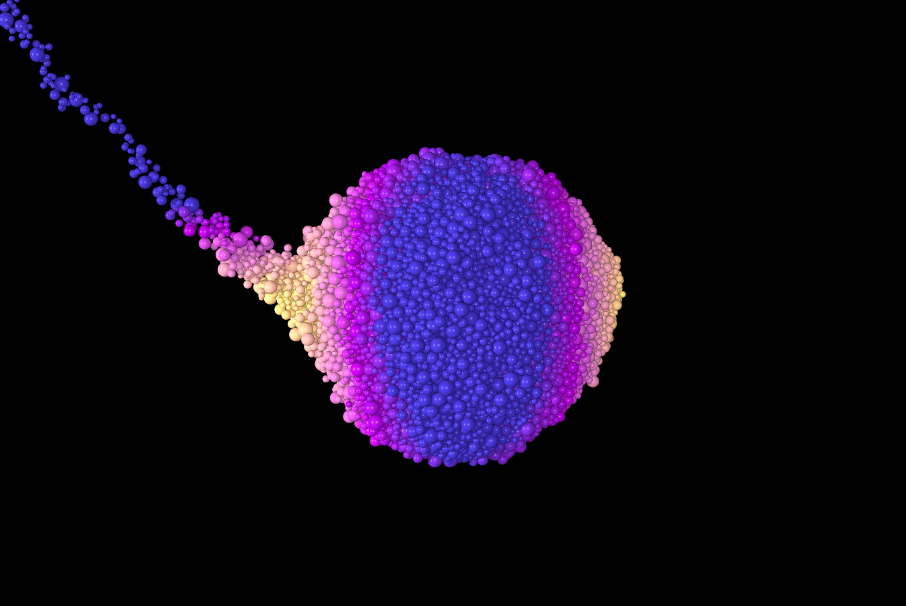
Phobos, the Doomed Moon :
Why Mars Will Erode and Then Disrupt Its Satellite
Nice, France – A pair of researchers from Université Côte d’Azur, Observatoire de la Côte d’Azur (OCA), and the CNRS Lagrange Laboratory have published a study that included a featured image on the Astronomy & Astrophysics journal, revealing that as Phobos, Mars’ largest moon, draws closer to the planet, it will first undergo surface erosion before being torn apart by Mars’ tidal forces. This disruption will occur at a greater distance from Mars than previously estimated. These findings, derived from numerical simulations and analytical estimates, assume that Phobos’ physical properties—particularly its low strength—are similar to those of recently visited asteroids. These properties will be measured by the Japanese Space Agency’s (JAXA) Martian Moons eXploration (MMX) mission, set to launch at the end of this year, with both researchers involved. The models and their results have implications for the origin, evolution, and fate of Phobos and can be applied to other small planetary moons.
A Doomed Moon: A Revised Scenario
Phobos, the larger of Mars’ two moons, orbits so close to the planet (about 9,000 km) that its orbit is inevitably decaying due to tidal forces. Previous models predicted its destruction near Mars’ Roche limit (about 1.6 Martian radii). However, this new study, led by Harrison AGRUSA and Patrick MICHEL (Lagrange/CNRS, OCA, UniCA), shows that Phobos will begin to break apart at 2.2 Martian radii (approximately 7,500 km from Mars’ centre)—much earlier than expected—if its mechanical strength is as low as that of recently visited asteroids.
Why?
If Phobos shares the characteristics of small asteroids, its structure would resemble a rubble pile, with rocks held together by their own gravity. The researchers demonstrated that, in this case, as it approaches a planet, tidal forces first strip material from its surface before causing total disruption. This previously overlooked mechanism explains why earlier estimates underestimated the disruption distance for the small moon.
"Our simulations assume Phobos is far more fragile than previously thought," explains Patrick Michel, CNRS Research Director and co-author of the study. "This assumption is supported by observations of small asteroids, which have shown very low strength. The gradual destruction of Phobos, rather than a sudden breakup, opens the door to new scenarios, such as collisional erosion accelerated by the ejected debris."
MMX: A Key Mission to Unravel Phobos’ Mysteries
These findings are timely for JAXA’s MMX mission, scheduled to launch in late 2026. MMX will study Phobos and Deimos in detail, with the following objectives:
- Returning samples to Earth by 2031 (to analyse composition and determine the origin of Mars’ moons).
- Measuring gravity and topography (to constrain cohesion and porosity models).
- Conducting mineralogical and elemental composition analyses from the spacecraft.
- Deploying the Franco-German rover IDEFIX® (CNES-DLR) for in-situ analysis.
"MMX will provide the missing data on Phobos’ structure," says Harrison Agrusa, a CNES postdoctoral researcher and lead author of the study. "This information will be crucial for refining our predictions and understanding whether Phobos is a captured object or re-accreted after a giant impact on Mars."
Implications Beyond Mars
This study is not limited to Phobos. It provides a new theoretical framework for understanding the fate of irregular small moons in the Solar System, such as those of Saturn or Jupiter. It also highlights the importance of space missions dedicated to small bodies, which allow testing models of celestial mechanics and planetary formation.
"Phobos is a natural laboratory for studying evolutionary processes and the fate of satellites," concludes H. Agrusa. "These coming years will teach us as much about its end as about its origin."
First author Contacts:
Harrison Agrusa: CNES Postdoctoral Researcher at Observatoire de la Côte d’Azur (Lagrange Laboratory, UniCA). Email: hagrusa@oca.eu.
Press Contacts:
Observatoire de la Côte d’Azur’s Communication Department.
Additional Resources:
Article: “Tidal disruptions of rubble piles: The case of Phobos”, H. Agrusa and P. Michel, Astronomy & Astrophysics, received: 05 November 2025 / accepted: 09 January 2026.